Schlei Summer School 2026


The 3rd iFOODis Summer School !!
Supported by iFOODis

DLR, GEOMAR, CUB & affiliated institutions

Update — May 2026: Dates are confirmed as 20–26 September 2026. Lectures and catering will be held at the AKZENT Hotel Strandhalle, Schleswig. Participants will be accommodated at Ferienwohnungen Alte Meierei, Twedt — walking distance from the field site. Details below ..

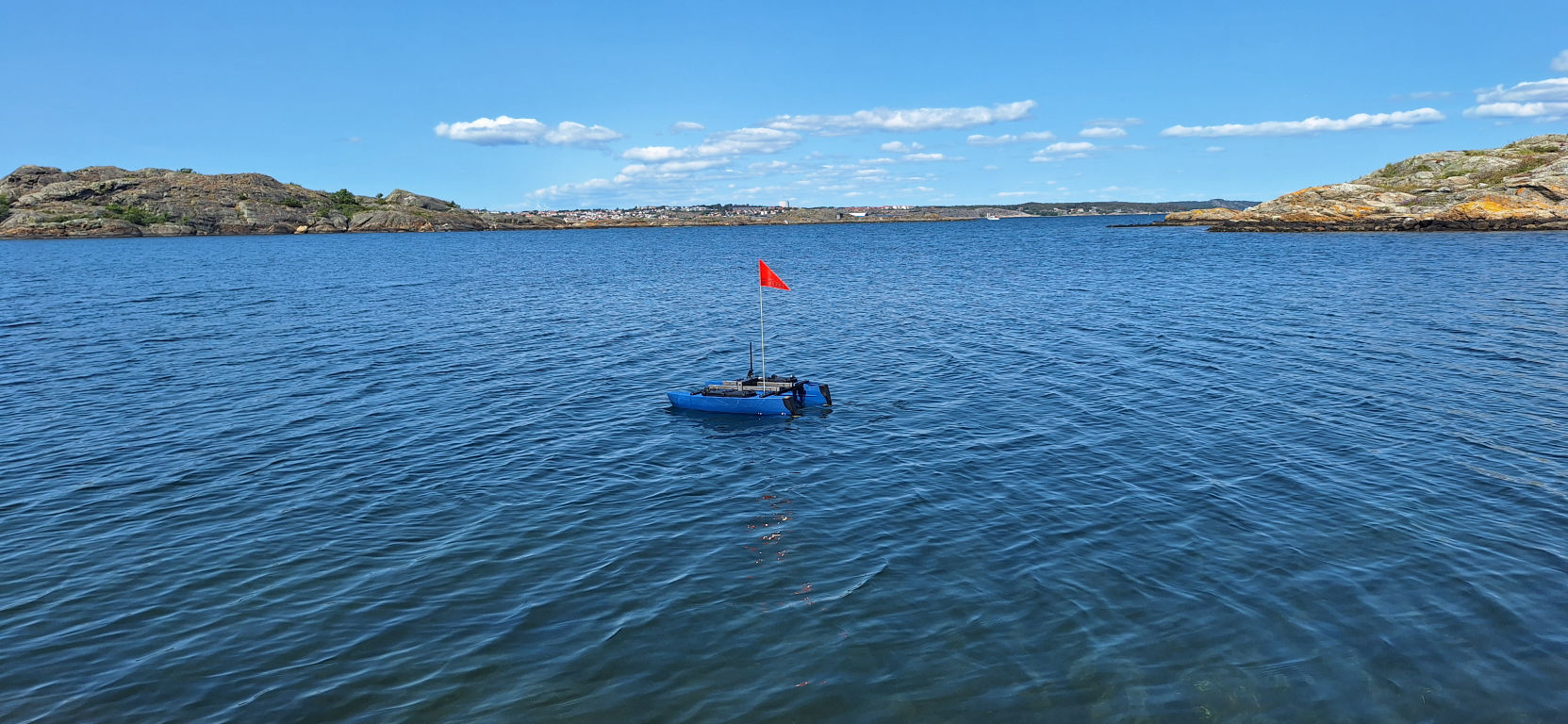
The school takes place in the Schlei, a narrow fjord-like inlet (Förde) on Germany's Baltic coast in Schleswig-Holstein — an outstanding natural laboratory for studying coastal eutrophication, sediment dynamics, and environmental change.

The Schlei Summer School 2026 is the third edition of the iFOODis field-based summer school series, following the inaugural Vulcano, Sicily 2023 edition and the Kristineberg/Gothenburg 2025 edition. It brings together early-career researchers from partner institutions — including DLR, GEOMAR, Constructor University Bremen, and affiliated universities — for an intensive, hands-on programme of coastal and marine data collection, processing, and analysis.

Join our Summer School
2026 - in Schlei, Germany

Dates:20th Sept. to 26th Sept.
Schlei, Schleswig, Germany 2026
The primary field site is located near Twedt (54.5889°N, 9.6835°E) on the southern shore of the Schlei, approximately 12 km east of Schleswig. Contact Vikram Unnithan by email to join.

Food & Accommodation

Lectures and catering will be held at the AKZENT Hotel Strandhalle, Schleswig. Ferienwohnungen Alte Meierei, Twedt — a beautifully renovated 1888 farmhouse, ~1.7 km from the field site. Additional Accommodation options are available here.

TRAVEL

Nearest airport: Hamburg (HAM), ~1.5 hrs by train. Regular trains from Hamburg to Schleswig. Local transfer details (Sprinter) provided to confirmed participants. Limited travel support available.

Support

Limited financial support (food and/or travel) is available. Contact the organisers early as funds are limited.
MUDS participants (Munich School for Data Sciences) should contact Prof. Trieble (DLR). 

Mobirise

The Summer School

The programme follows the proven iFOODis format: short introductory lectures paired with extended hands-on fieldwork and data analysis sessions. Participants work in small, interdisciplinary teams throughout the school.

Topics

Coastal Environmental Status
Distributed Sensing & Sensor Eggs
Localisation
IoT data flows
Agricultural & Land Use Pressures
Catchment-scale land use
Coastal water quality
Robotics
Remote Sensing & GIS
Data Collection & Processing

Working in groups

Participants work in small, interdisciplinary groups throughout the week — collaborating across robotics, oceanography, and geophysics. Researchers are encouraged to bring their own instruments, prototypes, and research questions to the field.

Mobirise

Learning by Doing !!

The majority of the programme is fieldwork- and lab-based. Short introductory lectures provide context; participants then operate equipment themselves and collect real data.

Daily Rythmn

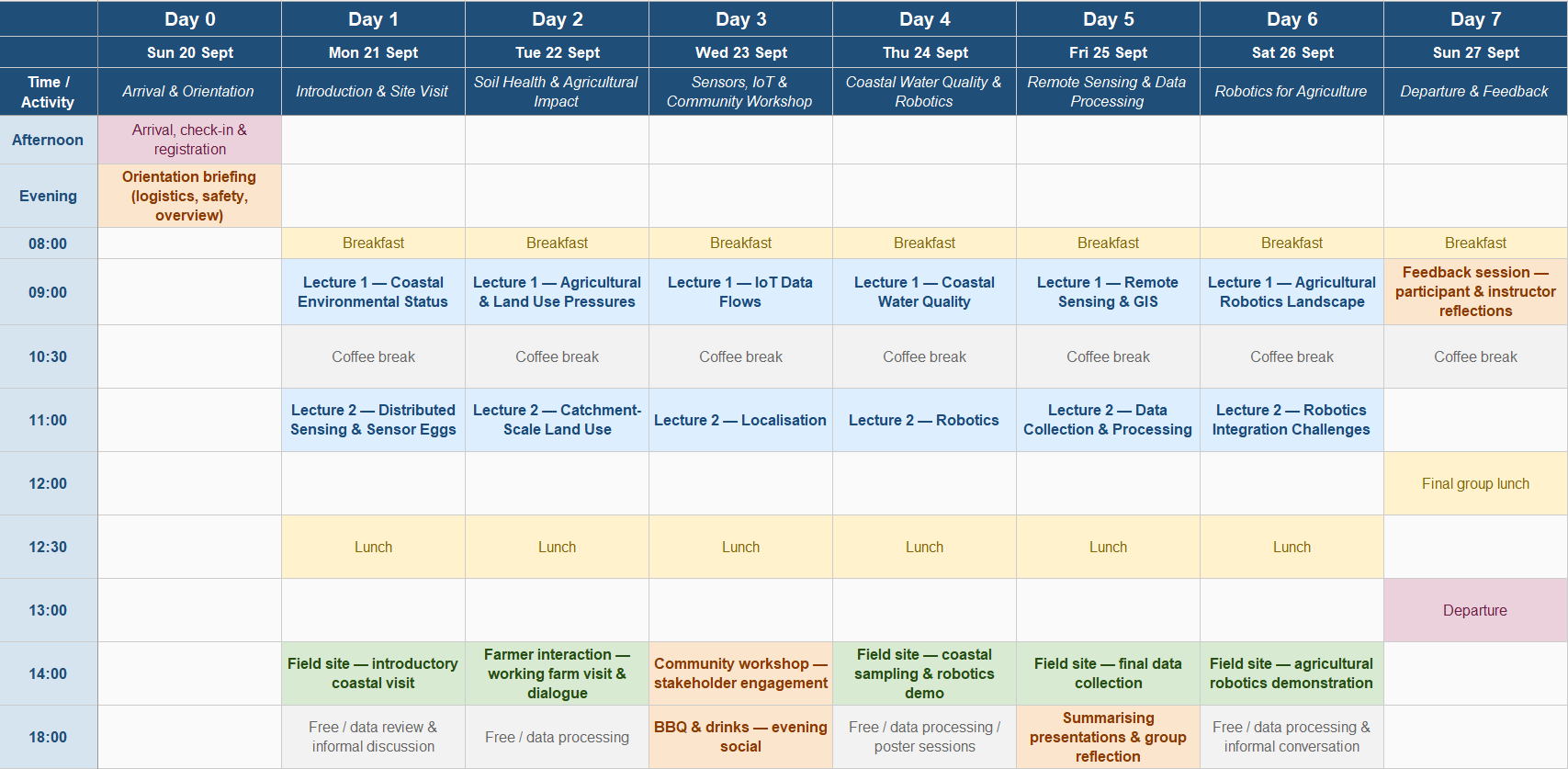
09:00 Lecture slot 1 → Coffee break → 11:00 Lecture slot 2 → 12:30 Lunch → 14:00 Field site → 18:00 Free / data processing / poster sessions

Draft Program Overview

Mobirise

Draft Program at a closer Glance

The current (draft) plans for the summer school (updated 20.05.2026)

1

Day 0: Arrival & Orientation (Sunday 20th Sept.) 

Participants are welcomed throughout the afternoon as they check in, collect their materials, and settle into accommodation. The evening is kept deliberately light — an informal mixer over drinks gives attendees the chance to meet fellow participants, instructors, and field staff before the programme properly begins. A brief orientation session rounds off the night, covering logistics, safety protocols for field work, and an overview of the week ahead.

2

Day 1: Introduction & Site Visit (Monday 21st Sept.) 

After breakfast, the morning's first lecture introduces the overarching theme of Coastal Environmental Status, setting the ecological and regulatory context that will frame much of the week's work. Following a coffee break, the second slot turns to Distributed Sensing and Sensor Eggs, giving participants their first look at the hardware and deployment strategies central to modern environmental monitoring. The afternoon field session puts theory immediately into practice with an introductory site visit, and the evening is left open for data review and informal discussion.

3

Day 2: Soil Health and Agricultural Impact (Tuesday 22nd Sept.) 

The morning lectures address Agricultural and Land Use Pressures and Catchment-Scale Land Use, drawing connections between upstream activity and downstream coastal health. In the afternoon, participants travel to a working farm, where they meet with farmers to discuss land management practices, the realities of agricultural pressure on water systems, and the practical limits of monitoring technology from a landowner's perspective. This exchange is deliberately two-way — scientists hear from practitioners, and farmers engage with the research.

4

Day 3: Sensors, IoT Data Flows and Localisation  (Wednesday 23rd Sept.) 

The morning lectures cover IoT Data Flows and Localisation, exploring how sensor networks communicate and how data is spatially referenced across landscapes. After lunch, rather than a standard field visit, participants take part in a community workshop, engaging directly with local stakeholders — residents, council representatives, and environmental groups — to understand how scientific findings translate into public concern and policy dialogue. This session is one of the most important of the week, and participants are encouraged to listen as much as they contribute. BBQ and drinks for an evening of networking.

5

Day 4:Nutrient Pollution in Coastal Waterways & Robotics (Thursday 24th Sept.) 

Morning lectures focus on Coastal Water Quality and Robotics, the latter covering autonomous platforms increasingly used for environmental sampling and survey work. The afternoon field session moves to a coastal site, where participants apply the water quality concepts from the morning alongside any robotic systems available for demonstration or deployment. The evening session is designated for data processing, with instructors on hand to assist.

6

Day 5:Remote Sensing (Friday 25th Sept.) 

This day covers Remote Sensing and GIS in the first lecture slot and Data Collection and Processing in the second — a fitting pairing that brings together the spatial and analytical threads running through the week. The afternoon field session provides a final opportunity for data collection before participants transition into synthesis mode. In the evening, the programme ends with summarising presentations, a chance for the cohort to unwind, reflect on the week, and enjoy an evening together before the final day.

7

Day 6:Robotics for agriculture (Saturday 26th Sept.) 

After the usual breakfast and morning structure, the first lecture explores the current landscape of agricultural robotics — from autonomous weeding and crop monitoring platforms to soil sampling drones and precision spraying systems. Following the coffee break, the second slot focuses on the integration challenges of deploying robotic systems in real farm environments: connectivity constraints, variable terrain, sensor fusion, and the human factors involved in getting farmers to trust and adopt these technologies. The afternoon field session takes participants to an agricultural site where robotic systems are either in active use or available for hands-on demonstration, allowing the cohort to observe deployment conditions that contrast sharply with the controlled coastal environments visited earlier in the week. The evening is left open for reflection, data processing, and informal conversation — many participants will find this day draws together threads from the farmer interaction day, the IoT and localisation lectures, and the earlier robotics session into a much sharper practical picture.

8

Day 7:Departure and Feedback  (Sunday 27th Sept.)

A structured feedback session in the morning invites participants to share what worked, what could be improved, and how the material landed. Instructors offer brief reflections on recurring themes and open questions emerging from the week's discussions and data. After a final group lunch, participants depart — leaving with field data, new contacts, and a richer understanding of the coastal and agricultural systems they've spent the week studying.

The main organisers are:

Armin

iFOODis Co-ordinator 

iFOODis
Summer School Co-ordinator

Supported by

Institutional support is provided by Constructor University (formerly Jacobs University), University of Gothenburg, and DLR. Third party funding by Helmholtz Foundation project iFOODIS

Address

Constructor University Bremen (formerly Jacobs University Bremen)
Campus Ring 1
28759 Bremen
Germany

Contacts

Email: info AT site.com
Phone: +49 421 200 40

Drag & Drop Website Builder